- BCA-registered contractor
- bizSAFE Level 4
- LEW-endorsed installations
- Sunday-Saturday, 24/7
- +65 8927 1658
- sales@bestvoltcontractors.com


Commercial Rewiring in Singapore for offices, retail, F&B, salons and shophouses
Commercial electrical rewiring planned around your operations, project schedule and electrical requirements — with phased or after-hours works where the premises needs to keep running.
BestVolt handles rewiring for businesses upgrading, replacing or reorganising their electrical installation as part of a renovation, expansion or an ageing system.
Call or WhatsApp +65 8927 1658
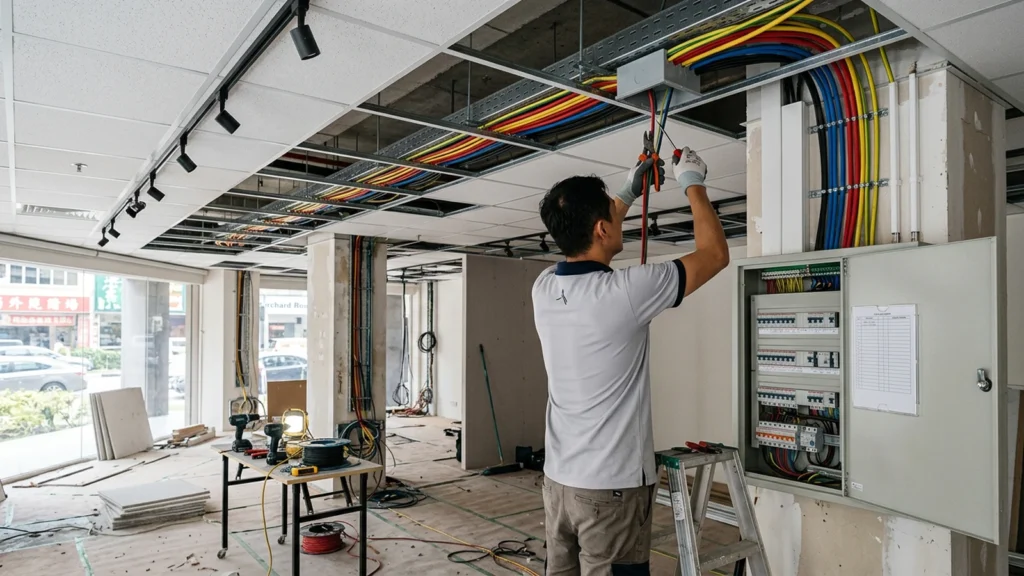
Registrations and Certificates You Can Check


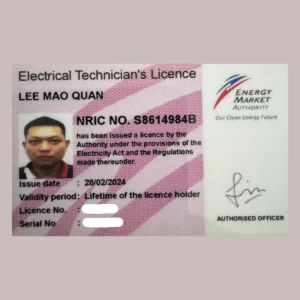




Commercial Rewiring for Businesses That Cannot Afford Unnecessary Disruption
Commercial electrical rewiring is different from rewiring an occupied home. A business may need to keep part of the premises operating while electrical work is carried out. Renovation schedules may already be fixed, equipment may need to be relocated, and unnecessary downtime affects staff, customers and daily operations.
A commercial project therefore needs more than new wiring. It needs proper planning around the existing electrical system, equipment loads, work schedules and final testing.
Recent Commercial Projects
Shops, offices and commercial units where we rewired, fitted out and upgraded boards.
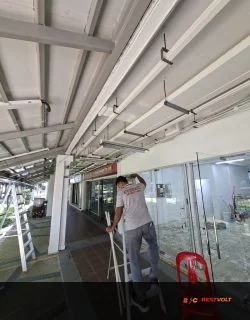 CommercialIndustrial / Commercial
Commercial & Industrial Wiring - Ubi Avenue 1
337 Ubi Avenue 1, Ubi, Singapore- DB box replacement
- Office power points
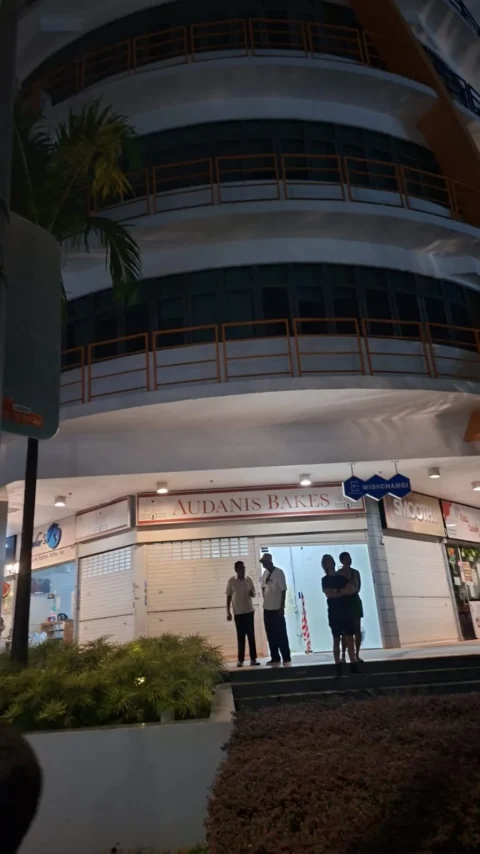 F&BF&B tenancy
Audanis Bakes - Shopfront & F&B Fit-Out
Audanis Bakes, unit 01-07, Singapore (building name not published)- Night shopfront with the Audanis Bakes sign on and the shutter down
- Wall point in the white shell, under the sign at unit 01-07
 OfficeOffice
Office Lighting Fit-Out
Office, Singapore (address not published)- Coloured geometric pendants lit over the desks
- Floor coordinated with cassette air-con and a green EXIT sign
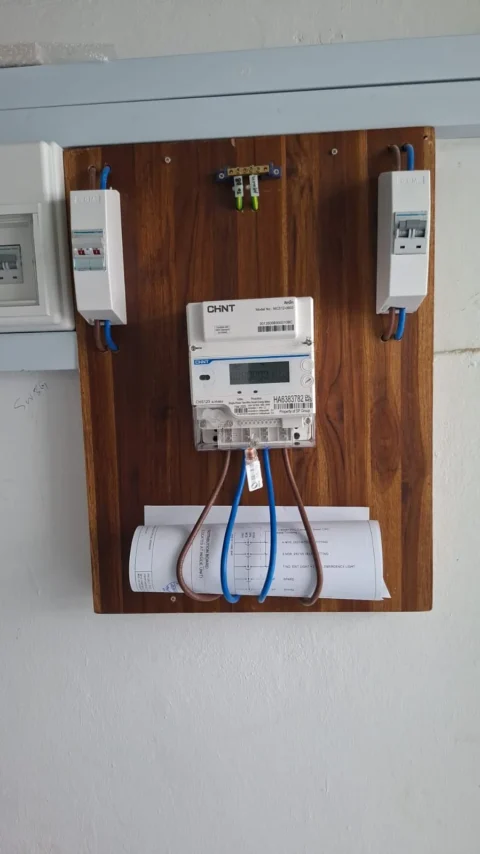 CommercialCommercial unit
SP Group Smart Meter & Meter Board
Commercial unit, Singapore (block and unit not published)- SP Group single-phase smart meter set on a timber board
- Isolators either side, earth bar above, drawing kept on the board
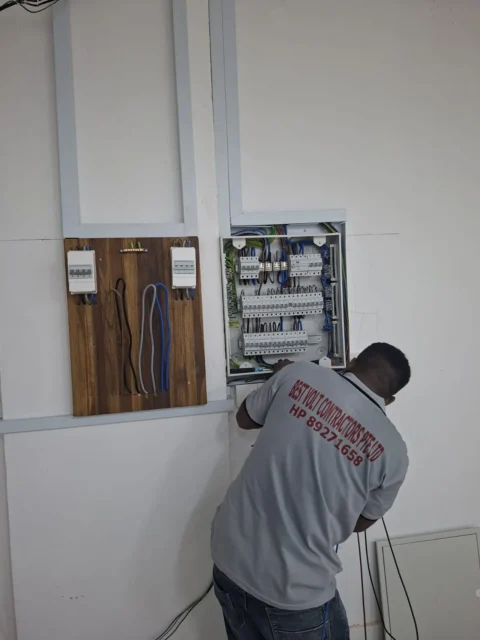 CommercialCommercial unit and F&B unit
Distribution Board Wiring & Mounting
Two Singapore sites: the meter-board commercial unit and the Audanis Bakes unit- Open-board termination in the meter-board commercial unit
- Circuit labels at the MCB row, including L1P1 and socket L2P4
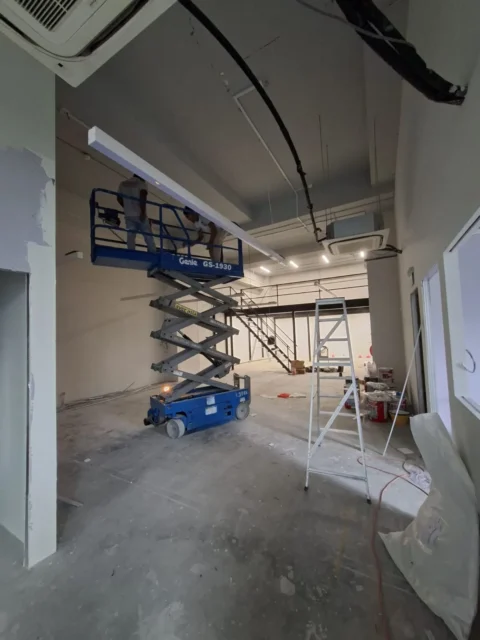 CommercialUnit with steel mezzanine
Mezzanine Lighting & High-Access Installation
Unit with a steel mezzanine, Singapore (address not published)- Linear fitting set from a Genie GS-1930 scissor lift
- Crew working the black steel mezzanine, ladder and lift in frame
Commercial Rewiring Process
From first enquiry to tested handover, the sequence is planned around the premises and how it operates.
- Initial EnquiryShare the property type, existing electrical situation, renovation plans and the work you are considering.
- Site AssessmentThe existing installation and proposed electrical requirements are reviewed to understand the actual scope.
- Rewiring Plan and QuotationThe work is planned around the property layout, electrical requirements and project schedule.
- Site PreparationElectrical routes, shutdown arrangements and coordination with other works are confirmed before installation.
- Rewiring and InstallationThe agreed electrical works are carried out according to the planned sequence.
- Testing and HandoverThe completed installation is checked and tested before handover, with relevant documentation where applicable.
What Our Clients Say About Our Work
Real reviews from homeowners and businesses, pulled from our Google Business Profile.
Trustindex verifies that the original source of the review is Google. Highly recommended! I engaged them for the rewiring of my HDB, and I’m very happy with their service. The work was efficient, fast and professional, and the pricing was reasonable too. The electricians, Alam, Zaman and Masud, were all very good guys, friendly and professional throughout the job. They were also very responsive and quick to arrange an appointment whenever I needed them. Reliable, efficient and good value for money. Would definitely recommend them to anyone looking for electrical and rewiring works!Posted on GoogleTrustindex verifies that the original source of the review is Google. From the beginning , i was dealing with Mr Masud. He came to discuss n finally we engaged his company to rewiring our whole hse. He completed doing his job n came bck few times to rectify minor work. He also fixed for me water heaters, fans, data points etc.Well done Mr Masud. TqvmPosted on GoogleTrustindex verifies that the original source of the review is Google. As a first timer doing renovation, I was extremely careful in selecting which company to engage to do my house renovation. I was skeptical with all reno firms as I heard alot lf horror stories. But my initial gut feel tells me Bestvolt can be trusted & I was right! When I bought my resale flat which was in super bad state, I wasnt confident that anyone including Bestvolt can do much magic but I was proven wrong! Prior to engaging them, I have enquired over 20+ reno companies and I was very glad that I have chosen BestVolt in the end! Best choice I made for Year 2026! Haha. From plastering to electrical rewiring to painting, Bestvolt workers did an extremely good job, their workers were all skilled & know what they are doing & the end results is so good that I went WOW! Kudos to the person who replied my whatsapp queries, he was super patience (as It was my first time doing reno), I asked tons of questions but their patience is mainly what made me decided to engage them. Before engaging Bestvolt, in fact I have dropped another reno firm because their staff wasnt patience enough. I dont have an ID to save cost hence alot of things I dont know but Bestvolt explained everything to me in details. I also did compared over 20+ quotes and Bestvolt prices are very very reasonable. The workers were very fast in completing all the tasks & they were all very easy going despite me being fussy at certain point. I have since introduced Bestvolt to my friends & will continue to do so. I even told my friends if 5 years later I buy house again & want to reno, I will definately engage Bestvolt again!!!Posted on GoogleTrustindex verifies that the original source of the review is Google. It was quick hassle free service and in very reasonable price.Posted on GoogleTrustindex verifies that the original source of the review is Google. service is very good and patient. price very reasonable 100% recommend the teamPosted on GoogleTrustindex verifies that the original source of the review is Google. Great service! Super fast installation.Posted on GoogleTrustindex verifies that the original source of the review is Google. Fast and efficient changing of light bulb socket and installation of new PowerPoints. Thank you so much Best Volt. All of it took only 3 hours to change the whole house 14 power points! Would do so again.Posted on GoogleTrustindex verifies that the original source of the review is Google. Really great service alam and Jaman came down to my house for free quote and gave great advice. Conceal wiring, got me USB c plate, aluminum rail and install light steip. They made my vision come to life even though other contractors were apprehensive. They also helped to advise painters to cover up the work. 💯 Would recommend.Posted on GoogleTrustindex verifies that the original source of the review is Google. Masud and his colleagues had done a magnificent job on the rewiring of my HDB unit. A big thank you to them. I’m very please with the work carried out and even work late to complete the work.Posted on GoogleTrustindex verifies that the original source of the review is Google. I engaged Bestvolt contractors to rewired my HDB unit. Mr Masud and his colleagues had done a very good job. They were friendly, patience and willing to help to solve my many little request. They even responded promptly when I faced little problem after the job was completed. I would thank them for a marvelous job done. Well done!
When Does a Commercial Property Need Rewiring?
Rewiring may be considered when the existing electrical installation no longer matches the way the premises is being used.
The right scope depends on the existing installation and the proposed use of the property. A site assessment helps determine whether the project needs full rewiring, partial rewiring, additional circuits or related electrical upgrades.
Common situations
- Older wiring that needs replacement
- Electrical circuits that no longer suit the business.
- Renovation or commercial fit-out works
- Expansion requiring additional electrical capacity
- New equipment or appliances being introduced
- Changes to the layout of the premises
- Additional power points and circuits
- Existing wiring that is difficult to maintain or modify
- Electrical work that needs better organisation of circuits
- A planned refurbishment of an older commercial space
Commercial Rewiring for Different Business Premises
Commercial electrical requirements vary with the type of business, the equipment in use and the operating schedule.
Offices
Office premises may need changes to power distribution, workstations, meeting rooms and equipment areas as the layout changes.
Retail Shops
Retail spaces often need electrical work coordinated with lighting, display areas, signage, counters and other shop equipment — for both the current layout and the completed fit-out.
F&B Outlets
Restaurants, cafés and other F&B premises have a higher concentration of equipment and a more demanding environment. Rewiring is coordinated with kitchen equipment, service areas, refrigeration, lighting and sockets.
Salons and Studios
Salons, studios and similar businesses may need multiple circuits and conveniently positioned power points for equipment, lighting and workstations.
Shophouses
Shophouses can be more complex depending on layout, age, number of levels and existing distribution. A site assessment establishes the appropriate scope before work begins.
Minimise Business Disruption During Rewiring
One of the main concerns with commercial rewiring is how the work will affect normal operations. A practical project plan should consider:
- Which areas need to remain operational
- Which circuits can be isolated during the work
- When electrical shutdowns can take place
- Whether work can be carried out outside normal operating hours
- How the rewiring sequence fits the renovation programme
- When testing and final handover can be completed
The exact arrangement depends on the property, scope and site requirements. The point is to plan the electrical work around the business rather than treating the installation as an isolated task.
After-Hours and Weekend Commercial Electrical Works
Some businesses cannot simply stop operating during normal working hours. Where the project allows it, commercial electrical work may be planned around:
- After-hours work
- Weekend work
- Phased shutdowns
- Area-by-area rewiring
- Renovation schedules
- Equipment relocation
- Planned electrical isolation
This is particularly useful for operating retail and F&B premises. The schedule should be agreed before installation begins so the business knows which areas are affected and when.
Electrical Load Planning for Business Expansion
Rewiring is often carried out at the same time as a business expansion or renovation. Adding equipment without reviewing the existing electrical arrangement can create problems later.
The objective is an installation planned around the business’s actual and expected requirements rather than simply adding more sockets to the existing system.
Planning may need to consider
- Existing electrical demand
- New equipment
- Additional circuits
- Distribution board capacity
- New power points
- Dedicated circuits for higher-load equipment
- Future expansion requirements
- Single-phase or three-phase requirements where applicable
What Commercial Rewiring Can Include
The final scope should be based on the site condition, proposed layout and electrical requirements of the premises.
A project may include
- Removal or replacement of existing wiring
- Installation of new electrical circuits
- New power points and socket outlets
- Distribution board-related works
- Circuit protection
- Concealed or surface wiring
- Conduit or trunking installation
- Wiring for renovated areas
- Electrical points for new equipment
- Circuit identification and labelling
- Testing after installation
- Documentation and handover
Concealed Wiring or Surface Trunking?
The appropriate wiring method depends on the property, existing finishes, renovation scope and access to the electrical routes.
Concealed Wiring
Concealed wiring can be considered when walls or ceilings are already being opened as part of a renovation, or when a cleaner finished appearance is required.
It generally needs more coordination with other trades, because the electrical routes have to be planned before surfaces are closed.
Surface Wiring and Trunking
Trunking is useful where hacking or opening finished surfaces is undesirable, or where easier future access matters.
The choice should be based on the actual site — existing finishes, renovation scope and access to the electrical routes — rather than appearance alone.
Commercial Rewiring During Renovation or Fit-Out
Electrical work should be coordinated with the overall renovation programme. Early coordination is especially important when wiring has to be installed before carpentry, ceilings, wall finishes or other works are completed.
This reduces the risk of having to reopen completed areas later.
A typical sequence
- Reviewing the proposed layout and electrical requirements
- Assessing the existing installation
- Planning circuits, points and electrical routes
- Coordinating with renovation or interior works
- Carrying out the electrical installation
- Completing testing and final checks
- Preparing the installation for handover
Testing and Handover Documentation
Rewiring does not end when the cables and electrical points have been installed. Testing is an important part of completing the work and confirming that the installation has been checked before handover.
Depending on the project, the handover process may include relevant testing, circuit identification and documentation.
Why Proper Planning Matters
For a business premises, electrical work affects more than the wiring itself. Poorly planned work can create avoidable problems with:
- Renovation scheduling
- Business operations
- Equipment installation
- Electrical capacity
- Access to wiring routes
- Final handover
- Future modifications
A clear scope at the beginning makes it easier to coordinate the electrical work with the rest of the project. The aim is an installation that matches how the premises is used and how the business expects to operate.
What Affects the Cost of Commercial Rewiring?
There is no single price for commercial rewiring because the scope varies significantly between premises. A site assessment is far more useful than estimating the project from floor area alone.
The quotation may depend on
- Size and layout of the premises
- Existing wiring condition
- Full or partial rewiring
- Number of circuits
- Number of power points
- Concealed wiring or surface trunking
- Accessibility of wiring routes
- Distribution board requirements
- Electrical load requirements
- Renovation and fit-out coordination
- After-hours or phased work
- Testing and documentation requirements
Commercial Rewiring Questions We Often Get
How long does commercial rewiring take?
It depends on the size of the premises, existing wiring, number of circuits, access, renovation coordination and whether the work is carried out in phases or after hours. A site assessment is needed before giving a realistic schedule.
Can commercial rewiring be done after business hours?
Where suitable, electrical work can be planned around after-hours or weekend periods to reduce disruption. Feasibility depends on the property and project scope.
Does commercial rewiring require the whole premises to shut down?
Not necessarily. Some projects can be planned in phases or around specific shutdown periods. The arrangement depends on the existing electrical system and how the premises operates.
Can rewiring be done during a commercial renovation?
Yes. In many renovation projects the wiring needs to be coordinated with the fit-out programme. Planning the electrical routes early helps avoid conflicts with ceilings, walls, carpentry and other works.
Do I need to upgrade the distribution board when rewiring?
Not every project requires a distribution board upgrade. It depends on the condition and capacity of the existing board and the electrical requirements of the premises.
What if my business needs more electrical capacity?
If the existing supply or capacity is not sufficient for planned expansion, the project may require an electrical loading or power supply assessment. This should be considered alongside the rewiring scope rather than after installation.
Can commercial rewiring include new power points?
Yes. New power points and dedicated circuits can be included where required, based on the proposed layout and equipment requirements.
Will the electrical installation be tested after rewiring?
Testing forms part of the completion and handover process. The specific testing and documentation requirements depend on the project and installation.
Related Services
If you are still scoping the project, these pages may also help.
Electrical Rewiring Services
Full and partial rewiring scopes, methods, testing and handover.
Industrial Rewiring
Factory and warehouse electrical rewiring and coordination.
All Electrical Services
DB box upgrades, power points, testing, data cabling and more.
Prices & Packages
What affects an electrical rewiring quotation in Singapore.
Plan Your Commercial Rewiring
Whether the project involves an older commercial property, a renovation, a business expansion or a complete electrical overhaul, the first step is understanding the existing installation and the requirements of the finished space. Share the property, operating schedule and planned electrical works so the rewiring scope can be planned around your project.
- BESTVOLT CONTRACTORS PTE. LTD.
- 406 Pandan Gardens, #14-38, Singapore 600406
- Phone / WhatsApp: +65 8927 1658
- Email: sales@bestvoltcontractors.com
Request a commercial site survey
Tell us the premises type, operating hours and planned works, and we will arrange a site survey.
Prefer to talk? Call or WhatsApp +65 8927 1658.